3 February 2026

Introduction
Modern microbiology is increasingly driven by large and complex datasets. As sequencing technologies advance, researchers can now explore entire microbial communities through metagenomics and other omics approaches. But with this explosion of data comes a growing challenge: how do we ensure that research results are transparent, reproducible, and reusable?
This is where the FAIR principles come in. FAIR stands for Findable, Accessible, Interoperable, and Reusable, a set of guidelines designed to improve how scientific data and software are managed and shared. The ultimate goal of FAIR is simple: to make research outputs more useful, not just today, but for future studies as well.
The challenge of putting FAIR into practice
While most scientists agree that FAIR principles are valuable, actually implementing them is far from trivial. Many research projects still rely on ad hoc data management practices, custom scripts, and poorly documented workflows. Achieving FAIR compliance often requires specialized knowledge in metadata standards, data infrastructure, and programming; skills that are not always part of traditional scientific training.
As a result, researchers face a major barrier: the lack of standardized tools and infrastructure that make FAIR easy to adopt in everyday research.
Enabling trust through provenance
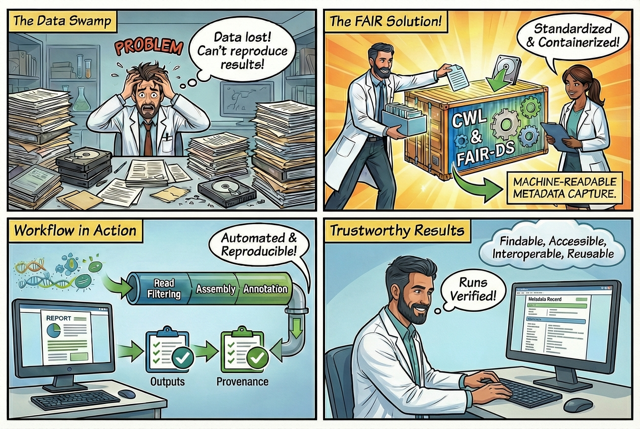
In our work, we set out to address this gap by developing a metadata-managed, containerized, end-to-end workflow for metagenomic analysis. The idea was to create a pipeline that not only processes data, but also documents itself—capturing how results were produced; with which tools, parameters, and input data.
To achieve this, we combined the FAIR Data Station for harmonizing experimental metadata with the Common Workflow Language (CWL) for executing the computational pipeline. Together, these components form a practical implementation of FAIR for Research Software (FAIR4RS), bridging wet-lab experiments and computational analysis in a transparent and traceable way.
We tested the workflow using defined mock microbial communities, which provided a controlled environment to evaluate performance, robustness, and repeatability across multiple runs.
Reproducibility in practice
A key focus of the study was reproducibility. For each dataset and assembler configuration, we performed multiple independent runs of the workflow. The resulting Metagenome-Assembled Genomes (MAGs) showed a high degree of consistency in both quality and composition, demonstrating that the workflow produces stable and repeatable outputs when applied under the same conditions.
This kind of systematic provenance tracking builds trust in computational results. Researchers can not only see what the outcome is, but also how it was produced, step by step.
MAGs as consensus genomes
One important conceptual insight from the study relates to the nature of MAGs themselves. Metagenome-assembled genomes are not exact representations of individual organisms; instead, they are consensus sequences derived from complex microbial populations.
We observed evidence of strain amalgamation, highlighting a fundamental property of metagenomic assembly: MAGs inevitably blend genetic signals from closely related strains. This means that all metagenomic assemblies, to varying degrees, represent consensus genomes rather than true isolates.
The practical implication is clear: researchers should interpret MAG quality metrics in the context of biological complexity, not just technical performance.
Toward more transparent microbial research
By embedding metadata, provenance, and standardized workflows directly into the analysis process, end-to-end FAIR-by-design approaches offer a powerful way to improve transparency, reproducibility, and long-term reuse of microbial omics data.
In a research landscape where datasets grow larger and more interconnected every year, FAIR workflows are not just a technical improvement; they are becoming an essential infrastructure for trustworthy science.