13 October 2026

Background
Microbial communities are complex and dynamic systems whose functions emerge from interactions between many difficult to culture microorganisms. Metagenomics is an essential data-intensive tool for microbiome research, enabling culture-independent profiling of microbial diversity and functional potential.
Extending the state of the art: Fair by Design
Machine-actionable minimal information models such as MIxS now capture structured details of experimental research conditions, and dedicated submission tools such as the FAIR data station* use these models to lower the barrier to compliant metadata registration. Yet the computational workflows that transform these raw data into derived products remain a largely unaddressed frontier: extending the FAIR principles, and their research-software counterpart FAIR4RS, to cover data processing and analysis workflows would greatly facilitate better use and reuse of processed data, extracted information, and derived knowledge.
*To date the FAIR Data Station has been used to support over 380 sequence database submissions.
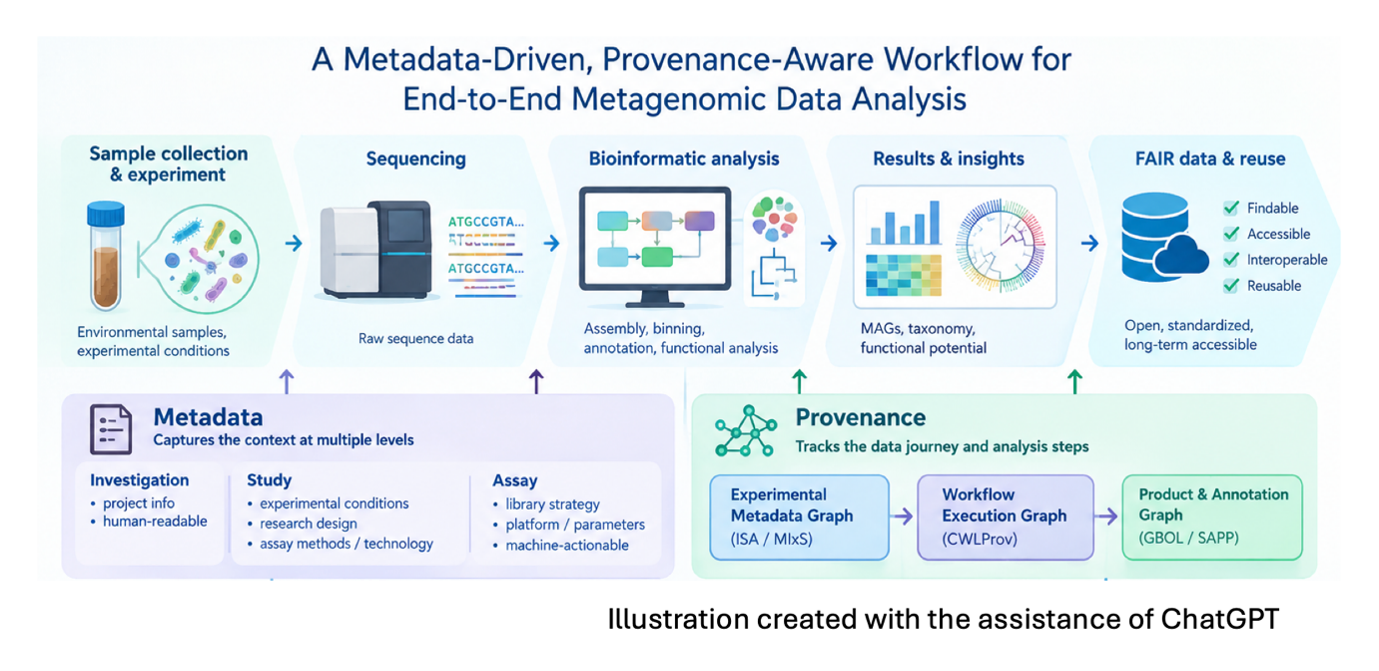
A FAIR end-to-end metagenomics workflow therefore should be able produce three main types of metadata: source and sample material metadata, describing the experimental conditions under which raw omics data were obtained; software-centric operational metadata, describing details of software tools and parameter settings used in data transformation, and metagenomics product (e.g. MAG) quality metadata describing intrinsic properties of the data products including accuracy, completeness, and consistency. With a rapidly expanding landscape of methods and tools (-and versions), each introducing different strengths and limitations, rigorous data-provenance tracking is critical to ensuring transparent and trustworthy (re)use of this annotated processed data. As proof of concept, we built a FAIR end-to-end metagenomics workflow.
Working principle
The ISA metadata model embedded in the FAIR data station captures experimental metadata at three levels: ’Investigation’, ’Study’, and ’Assay’. The Study and Assay levels outline the research design type (e.g., a time series design), the library source (e.g. metagenomic), the library strategy (e.g. WGS: Whole Genome Sequencing), and the technology platform used (e.g., OXFORD NANOPORE). These interoperable metadata fields go beyond describing the experiment: they provide the machine-actionable context that drives processing of the linked raw sample data through a containerized modular workflow in which each workflow step reports its own interoperable operational metadata. Subsequently, the processed data is annotated via SAPP, a FAIR-compliant semantic framework designed for functional genome annotation and analysis.
Why it matters: interoperability as research tool.
FAIRification of datasets is still commonly treated as a secondary step performed after data analysis. This overlooks the benefits of integrating standardized metadata from the outset, as experimental conditions directly inform how raw data should be processed. Capturing experimental metadata early in the process can facilitate FAIR-compliant downstream analysis, enabling seamless cross-comparison between samples and with public biological databases, and enhance the reproducibility of functional insights through standardized metadata structures. Finally, this is not just about being FAIR: integrating FAIR-compliant data analysis establishes a grounding layer for agent-assisted data analysis: FAIR metadata, persistent identifiers, provenance and executable workflows provide the mechanisms needed to make an AI agent traceable and scientifically accountable.
Code availability
• The CWL workflow definitions are registered on WorkflowHub.
• Their source repository is visible here.
• Analysis notebooks and scripts are hosted here.
• The Zenodo record provides example CWL configuration files and SPARQL query templates for the reported summaries.
• A minimal execution route is to install CWLTool and Docker, obtain a workflow definition and its matching YAML input file, and run cwltool –parallel workflow.cwl input.yml; setup guidance is available here.
• GraphDB or another SPARQL-compatible triple store is optional for querying the RDF provenance and functional-annotation graphs.
• The workflow has been tested on Linux x86_64 systems.