Knowing how to steer fermentation processes in the right direction
24 July 2025
What are the strings to pull to steer fermentation processes in such in way that they deliver exactly the desired products? This question eminently belongs to the UNLOCK Parallel Cultivation Platform, says platform manager Robbert Kleerebezem. Interesting for applications in the food industry, for instance. But also for companies looking to break down their waste flows by biological means. And it might just provide insights into the way in which food is converted in our intestines. Enough questions still to be answered by means of parallel experimental research in Delft.
Fermentation is the process during which sugars in grapes are converted into alcohol and what makes white cabbage change into sauerkraut. We have learned that this is the way it works, just like a farmer who knows exactly how to prevent decay of silage grass. And when you leave potatoes untouched for a while, the carbohydrates in the potato peel will ferment into butyric acid that can have a nasty smell. Robert Kleerebezem calls this anecdotical knowledge. And there is plenty of that kind of knowledge when it comes to fermentation processes. "Because the grape already contained yeast, we have learned how to make wine. When you do that properly, the grapes will ferment into a drink many people enjoy. That knowledge is valuable. But we have yet to find the proper answer to the fundamental questions behind that process: What exactly are the chemical factors and circumstances determining the direction the fermentation process is going?"
Kleerebezem is associate professor Environmental Biotechnology at the TU Delft. He calls himself a researcher driven by curiosity: "I like to look at processes in microbial communities. If I don't understand those processes, I use experiments to try and figure out how it works. That has helped me in the course of time to gain ever-increasing insights and enabled me to put together the pieces of the puzzle. To me, as a scientist, those are the most rewarding moments."
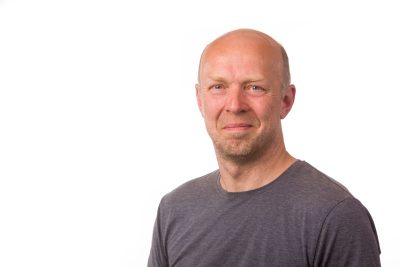
Robbert Kleerebezem
Sugars
Anaerobic conversions of organic carbon have his special attention. Like carbohydrates that can be converted by means of fermentation into products the industry needs. Companies that want to investigate the influence of specific process variables on the fermentation process can, according to him, turn to the Parallel Cultivation Platform: "Research conducted by laboratories into possible conversions is often limited to one or two experiments. Our platform has forty bioreactors, including controllers and online analysis tools. That makes it possible, for example, to investigate a microbial ecosystem in a large number of bioreactors under equal or different conditions in parallel and side by side."
Fermentation is a promising way to break down waste flows. "Our household waste largely consists of sugars. Suppose a micro-organism converts those sugars into lactic acid but you actually want it to produce biogas instead, you have to know what microbiological strings to pull. In all possible applications of fermentation, it is important to know what conversion takes place under which circumstances and how to influence the fermentation process in such a way that it produces a product that is useful for you."
Multiple experiments side by side
A micro-organism grows by means of catalysis of chemical reactions. The Parallel Cultivation Platform is particularly suited to measure those reactions in time: "Here we can conduct multiple experiments with the same organisms side by side, making it possible to properly compare the different circumstances. Samples from the biomass can then be further investigated to link the behaviour of the micro-organisms to the DNA, RNA and protein. Companies and knowledge institutions can use the Biodiscovery Platform and the FAIR Data Platform of UNLOCK to make this happen. I truly believe that to be a significant added value of UNLOCK: Here you will find the entire infrastructure and all the facilities and expertise needed for microbial research in one knowledge infrastructure."
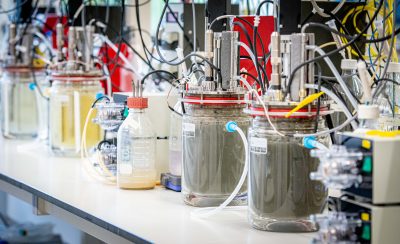
A look into the Parallel Cultivation Platform
Many contacts with potential clients who want to experiment with fermentations are already ongoing. In addition, research groups are using the facilities of the platform to investigate nitrogen compounds in the environment under changing circumstances. "By properly measuring these kinds of processes, insights may be gained into simple measures to minimise the harmful emissions."
"Experimental research continues to be crucial"
Although his personal interest is currently mainly focused on carbon conversions, there are still many questions unanswered around other elementary cycles, such as nitrogen. He hopes UNLOCK is an incentive for more research into fundamental insights on microbial ecosystems: "DNA techniques have evolved considerably, as is AI-driven research. As a result, experimental research, the establishment of cause-and-effect relations, could become overshadowed. However, it is my opinion that experimental research is crucial for the research field: Without this type of research the professional area of biotechnology can only develop to a limited extent."
Biotechnology cannot do without the 'earthly' experimental research work. "AI allows us to properly map correlations: Compare the milk of cows in one meadow with the milk of cows in another meadow to then determine how this would translate in human health. This type of research can therefore be used to formulate a hypothesis as to the possible relationships, but mechanistic insight into the processes requires targeted experimental research. And that is exactly what the Parallel Cultivation Platform specialises in."