7 March 2025
Introduction
The Parallel Cultivation Platform offers an innovative approach to studying microbial communities under controlled conditions. This case study highlights the experiences of Rifki Wahyu Kurnianto, a PhD candidate at Delft University of Technology, as he utilized the platform to investigate the role of magnetite in anaerobic phenol degradation. We asked Rifki about his findings and experiences within UNLOCK’s Parallel cultivation platform.
Tell us a little about yourself
I’m Rifki Wahyu Kurnianto from Indonesia, currently pursuing my PhD in the Department of Water Management, Faculty of Civil Engineering and Geosciences of Delft University of Technology.
What is the focus of your PhD project?
My PhD research is centered on investigating the potential role of magnetite in the anaerobic degradation of phenol within methanogenic microbial communities. Specifically, I’m exploring whether magnetite can stimulate Direct Interspecies Electron Transfer (DIET) between microorganisms involved in the conversion of phenol into methane-containing biogas.
That sounds incredibly fascinating! What led you to reach out to the UNLOCK research infrastructure for part of your experimental work?
The UNLOCK research infrastructure offers a unique parallel cultivation platform that allowed me to directly compare phenol degradation kinetics and stoichiometry with and without different concentrations of magnetite. The platform’s precise online measurement of methane and carbon dioxide production in batch reactors provided a level of accuracy that we simply couldn’t achieve in our own lab at the department of Water Managements. This was crucial for quantifying the impact of magnetite on phenol degradation.
What types of experiments did you conduct there?
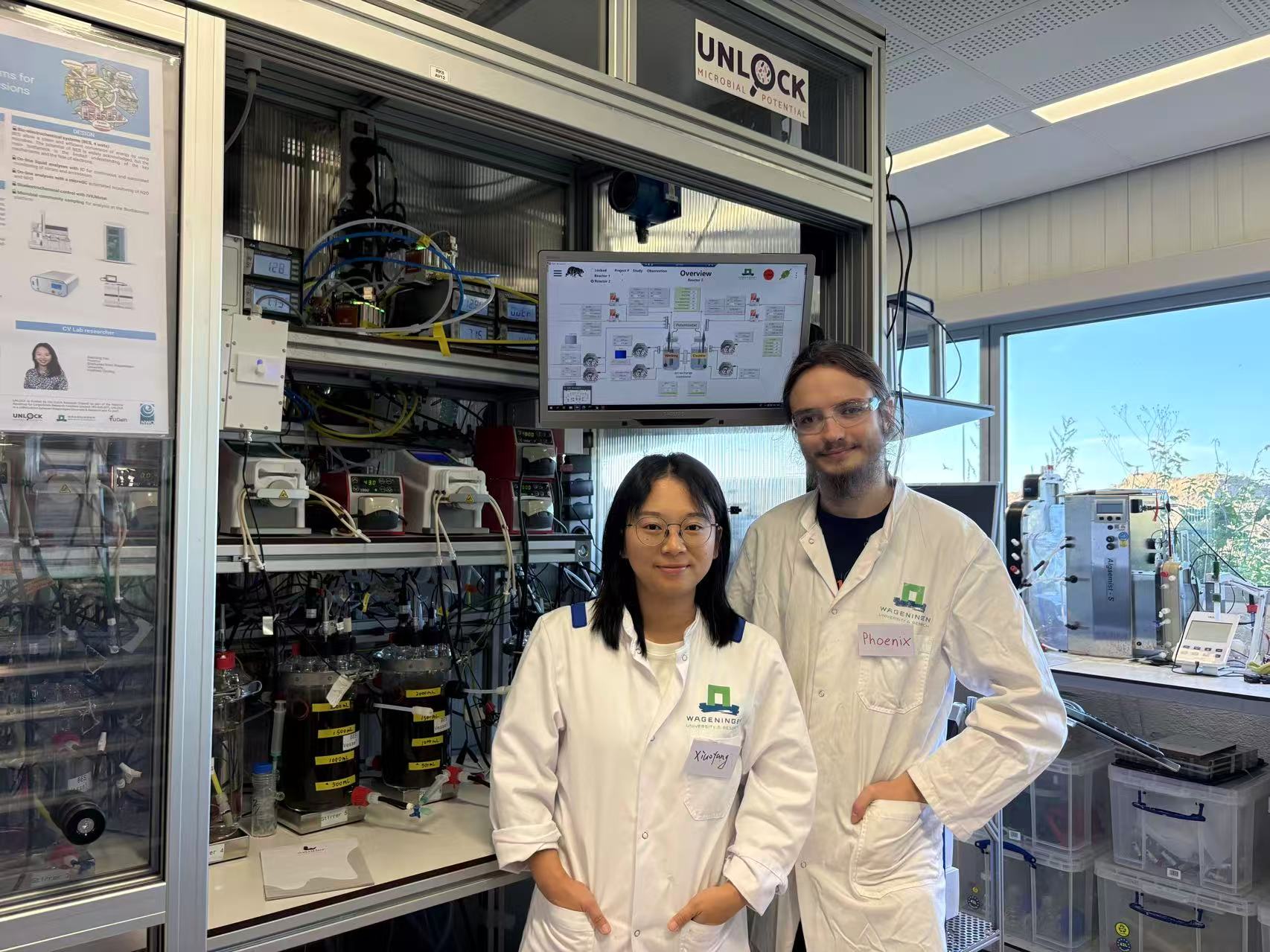
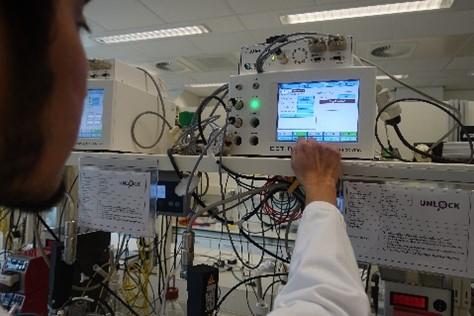
I operated three bioreactors, as shown in the picture, which were configured as both batch and fed-batch systems. The bioreactors were inoculated with biomass that I had cultivated in previous experiments. All three systems were identical, except for the amount of magnetite added. Over a two-month period, we conducted a series of experiments at varying phenol concentrations, including experiments where degradation intermediates were used as substrates.
Fascinating! What were the results of your experiments? Did magnetite accelerate the process?
Interestingly, we did not observe any significant difference between the systems with and without magnetite. All the systems behaved as perfect replicates, suggesting that DIET did not play a role in phenol degradation under the conditions we tested. However, we did uncover some fascinating physiological properties of the phenol-degrading microbial community. For instance, we identified the phenol inhibition constant, which quantifies phenol toxicity to the community. Additionally, we discovered that the community was highly sensitive to short periods without substrate. In fact, we observed that after just a brief substrate depletion, the entire community’s activity was lost. This is highly unusual for anaerobic communities and has important implications for the application of this technology.
What are your conclusions regarding the use of the Parallel Cultivation Platform for your research?
I believe the parallelization of bioreactor infrastructure, as demonstrated by the UNLOCK platform, offers unparalleled opportunities for researchers investigating cause-and-effect relationships within microbial communities. With forty identical bioreactors, each equipped with online analysis tools for a wide range of variables, the platform allows for direct, quantitative comparisons of microbial community physiology across different conditions. When combined with molecular community analysis, this approach enables us to pinpoint how environmental conditions influence microbial properties.
Even when anticipated effects, such as the impact of magnetite in my study, aren’t observed, the platform still provides valuable insights. I highly recommend it to any researcher in the field.